
This guide shows you exactly how to prepare for a technical interview in the UK…
Technical interviews aren’t just about skills
Most candidates think a technical interview is only a test of knowledge. It isn’t.
Interviewers are looking for both competence and fit. They want to see how you’ll work with engineers, office teams and stakeholders on site or across sites.
That’s good news. It means you can prepare to show both sides.
What interviewers really care about (the top four)
From thousands of engineering interviews, these matter most:
- Software and packages you’ve actually used. Be specific. Name versions. Share where you used them and why.
- Qualifications. Bring evidence of core tickets and non‑educational quals (NEBOSH, site licences, industry cards).
- Relevant experience. Tie projects to the role’s needs. Show scope, constraints and outcomes.
- Personal fit. Tailor your examples to their team, pace and standards. Show ownership and a calm, solutions‑first mindset.
What to expect in a technical interview
Typical stages and timelines
Most processes aren’t one‑and‑done.
Expect:
- A first stage focused on who you are and how you communicate.
- A second stage typically dives into technical fit. There may be a test or a task, but not always.
- Multi‑site roles can involve extra meetings with different stakeholders.
But clients are becoming more aware that the hunt for niche skillsets is cutthroat, so employers aim to move quickly, two stages then an offer is common in the current competitive market.
Pro tip: ring‑fence some annual leave for interviews. Two spare days a year keeps you flexible when slots are tight.
Remote vs face‑to‑face interviews
First stages are often on Teams for speed and flexibility.
TOP TIP: treat it like an in‑person interview!
- Dress properly.
- Test your audio, camera and screen‑share.
- Clear your background.
Technical interview checklist
Research the company and the people
- Go beyond the homepage. Read recent news, product pages and case studies. Then research your interviewers on LinkedIn. Look for common ground—sites you both know, shared tools, mutual contacts, or industry groups. Use this to build rapport and shape smarter questions.
Map your technical story (software, quals, experience)
- List the tools and packages in the job ad. Map each one to a project you’ve done. Note the version, your role, and a measurable outcome. Do the same for qualifications and tickets. Bring evidence where relevant.
Build a portfolio and STAR stories
- Create a simple portfolio: 3–5 projects, one page each. Include objective, your role, tools/standards used, constraints, safety considerations, and results. For interview answers, use STAR:
- Situation – the context
- Task – what needed doing
- Action – what you did
- Result – the outcome and learning
Practice out loud. Keep each STAR answer to 90–120 seconds.
Logistics
- You can’t overdress. You can only underdress.
- Confirm the location, ID and PPE requirements.
- For Teams, close apps, pause notifications, and keep your phone on silent and out of sight.
Proving technical fit without oversharing
Answering skills questions with evidence
Anchor every answer in evidence. Mention the system, platform, or standard. Explain the constraint and your trade‑offs. End with a result.
For example:
“On the XYZ line upgrade, I modelled the new PLC logic in TIA Portal v17. The constraint was a four‑hour changeover window. I pre‑built test cases, ran them on the bench rig, then deployed during a planned stop. We cut commissioning time by 35% and hit the restart window.”
Handling tests and assessments
If there’s a practical or coding test, clarify the brief first. Think aloud. Show how you handle unknowns and safety.
If no test is set, expect deeper project walk‑throughs. Bring your portfolio and be ready to screen‑share.
Showing team and culture fit
Body language
You’re in interview mode from reception onwards.
- Greet people warmly.
- Accept a drink if offered.
- Match their pace.
- Sit upright, feet planted, hands visible.
- Maintain comfortable eye contact.
- If you need a moment to think, take it. Silence beats rambling.
Smart questions to ask (and when not to ask about pay)
Your questions are part of your pitch. Try:
- “Is there anything in this role you don’t think I can do?” (Gives you a chance to address doubts.)
- “How will success be measured in the first 90 days?”
- “What are the main interfaces—sites, teams, suppliers?”
- “Which standards or software versions are front‑line here?”
Avoid salary questions unless they raise it first. If you’re represented by a recruiter, let them handle negotiations and the uncomfortable bits.
Mistakes to avoid (and how to recover)
- Bad‑mouthing employers. It’s a red flag. Reframe issues as learning points.
- Filling silence with jargon. Pause. Breathe. Ask clarifying questions. Then answer.
- Turning up underdressed. Default to smart. Prepare PPE if relevant.
- Not tailoring. Generic answers miss the mark. Use their language and tools.
- Social media slip‑ups. Lock down personal profiles while you’re job‑hunting.
If you stumble, own it. “Let me restart that answer more clearly…” Then use STAR.
After the interview: follow‑up that wins offers
Before leaving, reaffirm your interest and fit. And if the role and culture feel right, say so:
“If offered, I’d be happy to accept.”
Send a concise thank‑you within 24 hours. That confidence can sometimes help them close.
If you’re working with a recruiter, share honest feedback fast. We’ll compare notes with the client, position your strengths, and handle the negotiation.
Perks of working with a recruiter
- Sharper prep | Insider context on the role, team and stakeholders.
- Interview logistics handled | We align diaries, prep for Teams and F2F, and reduce stages where possible.
- Real‑time feedback | We gather specifics after each stage so you can adjust fast.
- Negotiation done for you | Salary, benefits, start dates and awkward bits handled by us.
- Market intel | Benchmarks on pay, shifts, and what similar firms are offering right now.
- Access to hidden roles | You’ll hear about briefs before they hit job boards.
The technical engineer interview process can feel lengthy. But with the right preparation, you’ll stay in control and give yourself the best shot.
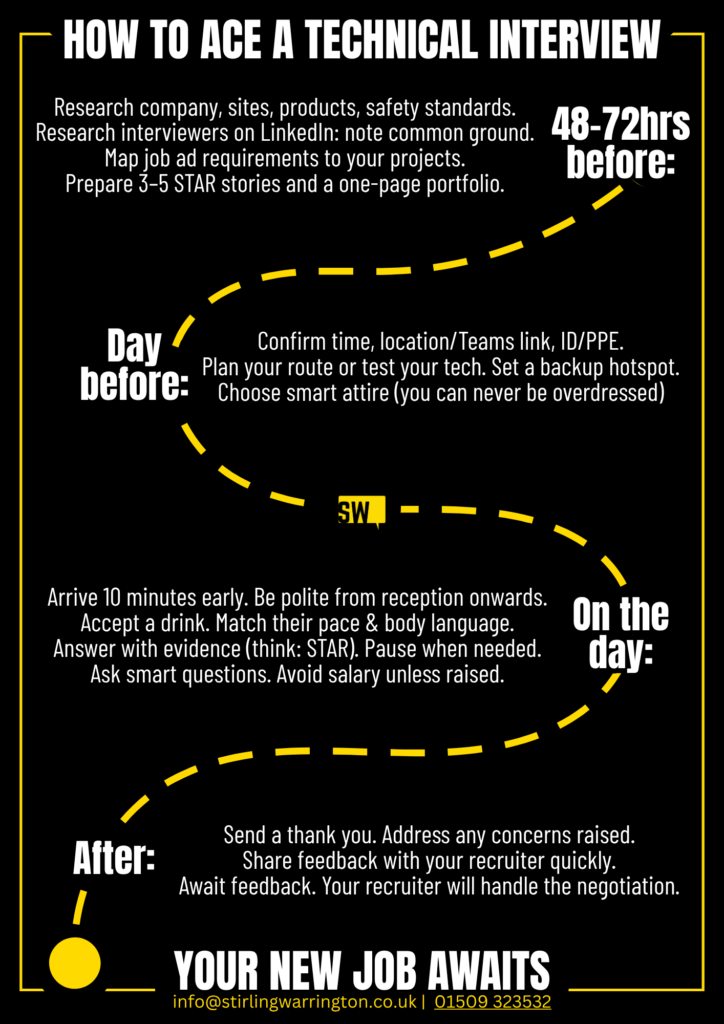
Use this give yourself the best shot:
Next Steps
Now you’ve mastered the art of interviewing, it’s time to get some lined up.
Or you can get in touch with me:

Scott Lydon
scott@stirlingwarrington.co.uk
07398 989 412
Design • Systems • Software • Quality • R&D • Projects • Supply Chain • H&S