
When it comes to hiring, doing it yourself can be costly.
It’s tempting to think skipping a recruiter saves money.
No fees, contracts, or middlemen. Why not just do it yourself?
But it’s not exactly that straight forward…
Skip to where the section you want to jump to:
An open vacancy drives downtime* and can result in:
- Lost time.
- Missed production targets.
- Overtime and burnout.
- Damaged morale (and more) across the team you already have.
- Higher costs!
*Downtime in UK manufacturing averages £5,121 per hour, but the minimum is £500 for smaller manufacturers. If a vacancy causes even 1 hour of downtime per day, that’s a minimum £500/day every day the vacancy is open.
Let’s explore how much DIY really costs and why it could be the most expensive “saving” you ever make.
The True Cost of a Vacancy
The Direct Cost
Without the right people in place, projects stall and customer satisfaction dips.
In sales: leads go cold and targets are missed.
In engineering: production slows and quality slips.
The Internal Cost
Top performers pick up the slack, leading to stress and burnout.
Over time, this can trigger more resignations – turning one vacancy into several and driving up overall cost.
The Strategic Cost
Every unfilled role leaves growth on the table.
In sales: that’s lost revenue and missed market share.
In engineering: it’s downtime, inefficiency, and delayed innovation.
That engineer you’re in need of is the difference between things running smooth and costly downtime.
Every week a role stays empty, your team works harder to pick up the slack.
A typical Maintenance Engineer salary is (according to our recent salary report) £45k.
- One week open = £2,500 lost in output, overtime or crisis cover
- 8 weeks DIY delay = £20,000 gone before you even fill the seat.
(Based on UK downtime costing min. £500/day per day)
That’s before you add on overtime/contractor costs and the long-term impacts. (A similar story goes for lift engineering)
Now think about sales. Every week an empty territory is left uncovered, competitors move in and customer accounts slip.
80% of ASMs our team have placed over the last year are on base salaries over £50k (you can check out our recent ASM salary report).
Based on the Cost of a Vacancy formula, an open ASM role really costs!
- 8 weeks DIY delay = £35,000+
(based on a turnover of £50m/year with 150 employees)
And the true cost is upwards of this base figure when you consider the long-term impacts – lost deals, slower pipeline, and rebuilding relationships once someone’s finally in seat.
And that’s before you even go about trying to fill the vacancy – which involves a lot.
The Cost of Filling a Vacancy
Hiring isn’t just about sticking an advert on Indeed. It’s time-intensive:
- Job advert writing & posting = 2 hours
- Screening candidates = 5 hours
- Arranging Interviews = 2 hours
- Actually Interviewing = 5 hours
- Follow-ups, feedback, 2nd stage = 3 hours
That’s 17+ hours of internal time per hire. Add job board credits, LinkedIn licenses, and the lost time managers spend doing this instead of selling or maintaining equipment… the costs of DIY hiring adds up fast.
Putting your vacancy on Indeed may feel like a cheap way to hire. But if you’re not using all of the job boards, you’re only seeing approx less than 10% of the market.
Whereas we utilise every single job board And tap into our personal networks of both active and passive talent. This reaches a whopping 98% of the market!
You’ll hire faster, better, and cheaper.
Read more about how working with a specialist recruiter to hire for your team saves money and time…
DIY vs Done-for-You
Here are some examples where we’ve helped businesses hire for their team, and reduced time to hire significantly.
Maintenance Engineering Case Study
One business in the fresh produce sector had been trying to hire a Maintenance Engineer for over 5 months.
When our South East engineering specialist picked up the vacancy, a top quality CV was sent that same day.
- First stage booked the day after
- Final interview within a week
- Offer made and accepted within 9 days
5 months of wasted time. 9 days to a result.
Lift Engineering Case Study
A big business in the industry was struggling alone with a Lift Engineer for 3 months!
The role was in a location that’s notoriously tough to find engineers in.
Once our industry specialist, Ravin, got on the task:
- He tapped into his network
- Sent a CV over on Sunday
- Arranged a phone interview the next day
- Later that week the candidate and hiring manager met in person
- Then the engineer started the following week
The months of time and financial investment reduced down to a matter of days once Ravin stepped in!
Building Materials Case Study
Forterra had been trying to recruit a sales role themselves. After 2 weeks of getting nowhere, they turned to us.
- Shortlist provided within days
- A few strong candidates interviewed
- Ended up hiring 2 of our candidates (that’s not just 1 role filled, but 2!)
- Time to hire = 3 weeks total
As Joe Parker, Head of Marketing, said:
“We would spend quite a lot of time looking through CVs before we’d find a shortlist. Whereas, working with Stirling Warrington, we’ve got a good shortlist to begin with.”
“The experience with Stirling Warrington was streamlined. Rather than us reading through 100 CVs on our own internal system, you could present us with 5 really high ones that we could sift through. It’s taken a lot of the workload off my table.”
If you’re curious about how we’ve helped other businesses hire and save money in the long run, we have several case study examples for you.
The Cost of a Bad Hire
It’s not just hiring slow that’s an issue, hiring wrong also costs.
According to the Recruitment & Employment Confederation (REC), a mis-hire costs you 2–3 times their salary:
- Wasted salary while they underperform
- Lost sales or production output
- Manager’s time spent firefighting
- Replacement recruitment and training costs
A single bad hire at £45k = £90k–£135k lost when you add up the knock-on effects.
The Team Impact Nobody Talks About
When a vacancy drags on (or is filled by the wrong hire) the wider team is hit by the effects:
For Engineering teams:
- more overtime
- higher sickness
- burnout
- mistakes
For Sales teams:
- larger territories to cover
- stretched relationships
- frustrated customers
- top performers eyeing up the competition
And for both, there can be more jobs at risk of coming up when the team are feeling these side effects.
So, the costs of DIY hiring isn’t just the money, it risks losing more of the good people you already have.
There’s also the fact that people don’t feel comfortable applying for roles at direct competitors. We’ve heard it firsthand from candidates that they will always use a recruiter and avoid applying directly at roles advertised by the company hiring.
Using a recruiter gives jobseekers that extra level of security, where they can speak with someone who is a step-back from the business they can confide in with 100% trust.
Formula: Calculating the Cost of a Vacancy (COV)
Use this simple formula to estimate how much an unfilled role is really costing your business:
Cost of Vacancy (COV) = (Annual Revenue ÷ Number of Employees) × Vacancy Impact Factor × Number of Days Vacant
Here’s what each part means:
- Annual Revenue – Your company’s total yearly revenue.
- Number of Employees – Total headcount across your business.
- Vacancy Impact Factor – The percentage of revenue the vacant role typically influences (e.g. 30–50% for most roles, higher for sales).
- Number of Days Vacant – How long the role remains unfilled.
Example:
A company turning over £50m with 150 employees means each person contributes around £333,000 a year, or roughly £1,281 per working day (based on 260 days).
If a key Area Sales Manager role (impact factor 70%) is vacant for 8 weeks (40 working days):
COV = £1,281 × 70% × 40 = £35,868
That’s the base cost!
The real figure is often upwards of this once you factor in lost opportunities, overtime, reduced team efficiency, all the factors we’ve covered in this article and more!
How a Specialist Recruiter Saves You Money
A good recruiter isn’t a cost. Think of us as an insurance policy:
- Faster fill times
- Pre-vetted, proven candidates without you lifting a finger
- Replacement guarantees if someone leaves
- Market salary data to keep you competitive
- Access to candidates who aren’t actively looking
- You only pay if you hire
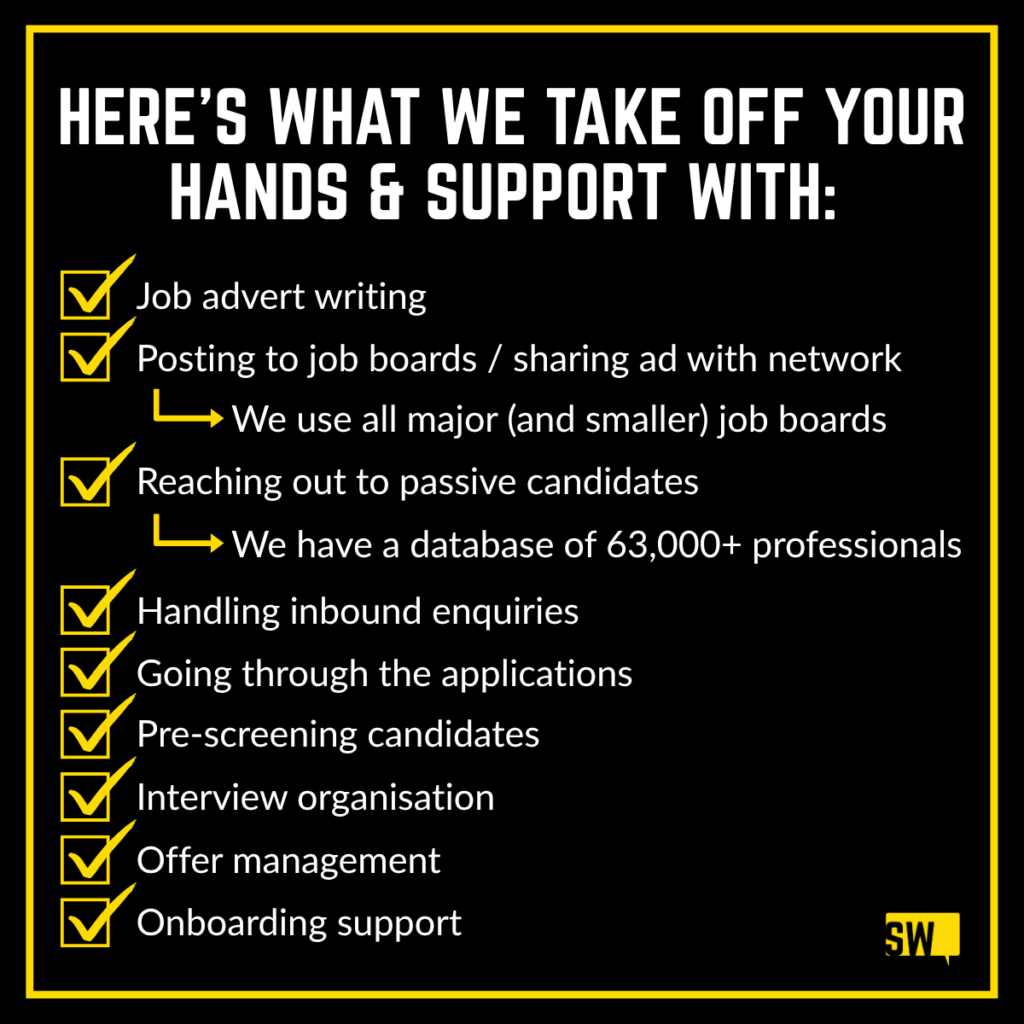
Here’s what we take off your hands, meaning your team can focus on their actual jobs:
Summary
Hiring DIY looks cheap until you run the maths.
What looks like a “saving” today, costs you £20k–£100k+ tomorrow.
Let us do it for you.
Contact us to get the ball rolling today.
You can use the buttons below to find your best port of call for hiring in your region.