


What are Maintenance Engineers actually earning in 2026? And perhaps more importantly, what would it take to make them move jobs?
Our previous Maintenance Engineer salary reports have looked at the salaries employers are advertising. And while they provided a wealth of insights into the current job market, this time, we’ve gone directly to the engineers themselves to uncover even more.
We surveyed more than 500 maintenance engineering professionals from our database, asking about their current salary, shift pattern, location, benefits, whether they are considering changing jobs and the salary they would expect if they did.
The result provides great insight into what engineers are actually earning – and what they want next.
Read on for some really interesting insights, whether you’re an engineer yourself or part of the team involved in hiring them!
Skip to the section that answers your question:
- How Much Do Maintenance Engineers Earn in 2026?
- Maintenance Engineer Salary by Skillset
- How Much More Do Maintenance Engineers Earn for Working Shifts?
- Maintenance Engineer Salary by Shift Pattern
- Maintenance Engineer Salaries by Region
- Are Lower-Paid Maintenance Engineers More Likely to Leave?
- What Benefits Are Maintenance Engineers Receiving?
- Do Better Benefits Help Retain Engineers?
- What Does It Actually Take to Make a Maintenance Engineer Move?
- What Does This Mean For Employers?
- What Does This Mean For Engineers?
- Advertised Salaries vs. Actual Salaries
How Much Do Maintenance Engineers Earn in 2026?
Across our respondents, the average base salary was approximately:
£51,040 per year
median of £50,000
Average Maintenance Engineer Salary 2026 (UK)
That’s before overtime and bonuses.
And interestingly, the average salary engineers said they would expect if moving jobs:
£54,697 per year
That’s around a 7.6% uplift
Average salary that Maintenance Engineers want to move jobs.
But there’s an important detail behind that number.
Out of the survey respondents:
- 75% wanted a salary increase to move
- 13% would consider moving for the same basic salary
- 2% would move for a lower salary
This suggests that there’s a small number of maintenance engineers who are keen to move roles and would take a pay cut for a more preferable location, employer, benefits package.
So, when we dig a little deeper…
Among engineers specifically looking for a pay rise, the average increase expected
=
11.5%

KEY TAKEAWAY:
When trying to attract somebody to a role primarily through salary, the uplift from their current salary may need to be closer to 10%+.
Maintenance Engineer Salary by Skillset
Engineering bias continues to make a difference. Here’s a quick snapshot of the insights:
| Engineering bias | Average current salary | Average desired salary | Average expected uplift | Considering moving |
| Mechanical | £47,176 | £50,851 | 8.9% | 54.9% |
| Electrical | £49,235 | £52,302 | 6.5% | 47.0% |
| Multi-Skilled | £51,236 | £54,561 | 7.1% | 51.2% |
Multi-Skilled Maintenance Engineers command the highest average salary of the three main engineering biases at just over £51,236.
Mechanical Engineers sit at the other end of the table, averaging approximately £47,176.
But Mechanical Engineers are also looking for the largest proportional jump when changing jobs. Their average expected uplift is 8.9%!
There is a retention point here too, as more Mechanical Engineers than any other bias said they were considering another role.
KEY TAKEAWAY:
For employers struggling to recruit mechanically biased engineers, simply matching their existing salary may be a difficult sell.
How Much More Do Maintenance Engineers Earn for Working Shifts?
Quite a lot. Engineers working days reported an average base salary of:
£48,479
For engineers working shift-based patterns, that rises to:
£53,212
That’s approximately a 9.8% salary premium for working shifts.
And the premium isn’t limited to one engineering discipline.
| Engineering bias | Days average | Shift average | Approx. shift premium |
| Electrical | £46,756 | £51,960 | 11.1% |
| Mechanical | £43,257 | £50,301 | 16.3% |
| Multi-Skilled | £46,834 | £53,516 | 14.3% |
Mechanical Engineers show the biggest difference.
A mechanically biased engineer working shifts earns around 16% more on average than one working days.
It reinforces something most Maintenance Engineering employers already know.
KEY TAKEAWAY:
If you’re hiring a maintenance engineer to work nights, weekends and rotating patterns, there needs to be a meaningful financial incentive for them.
Maintenance Engineer Salary by Shift Pattern
Looking at individual shift patterns gives us an even clearer picture.
| Shift pattern | Average current salary | Average expected salary | Considering moving |
| Days | £48,479 | £52,352 | 57.5% |
| Double Days | £48,668 | £51,864 | 41.3% |
| 3 Shift | £51,652 | £54,800 | 36.0% |
| 4 on 4 off | £54,551 | £57,708 | 55.2% |
| Panama | £54,666 | £58,565 | 50.0% |
| Days & Nights | £55,041 | £60,000 | 45.5% |
Some less common shift patterns had smaller response samples, so we’ve avoided drawing strong conclusions from them.
The main insights from the data:
- 4 on 4 off and Panama engineers are earning roughly £6,000 more than a typical days engineer.
- More days-based engineers are considering a new role than those doing other shift patterns (even when accounting for bias)
KEY TAKEAWAY:
The salary premium attached to shift work may be doing more than simply compensating people for unsociable hours.
Maintenance Engineer Salaries by Region
There are also clear regional differences.
| Region | Average current salary | Average expected salary | Considering moving |
| South East | £53,527 | £58,379 | 51.7% |
| London | £52,872 | £58,136 | 63.6% |
| South West | £52,560 | £57,400 | 54.5% |
| West Midlands | £51,818 | £54,383 | 47.8% |
| East Midlands | £51,593 | £54,900 | 50.6% |
| North West | £50,093 | £54,679 | 46.4% |
| Yorkshire & Humber | £48,904 | £52,384 | 61.4% |
| East of England | £47,184 | £54,933 | 62.5% |
Regions with smaller sample sizes should be treated as directional rather than definitive market benchmarks.
Unsurprisingly, London and the South East are among the highest-paying locations in our data.
But salary alone isn’t the most interesting regional finding:
- candidate mobility varies considerably by region
- more salary pressure in some lower-paying regions
Are Lower-Paid Maintenance Engineers More Likely to Leave?
Our results suggest they are.
Looking at engineers by current salary:
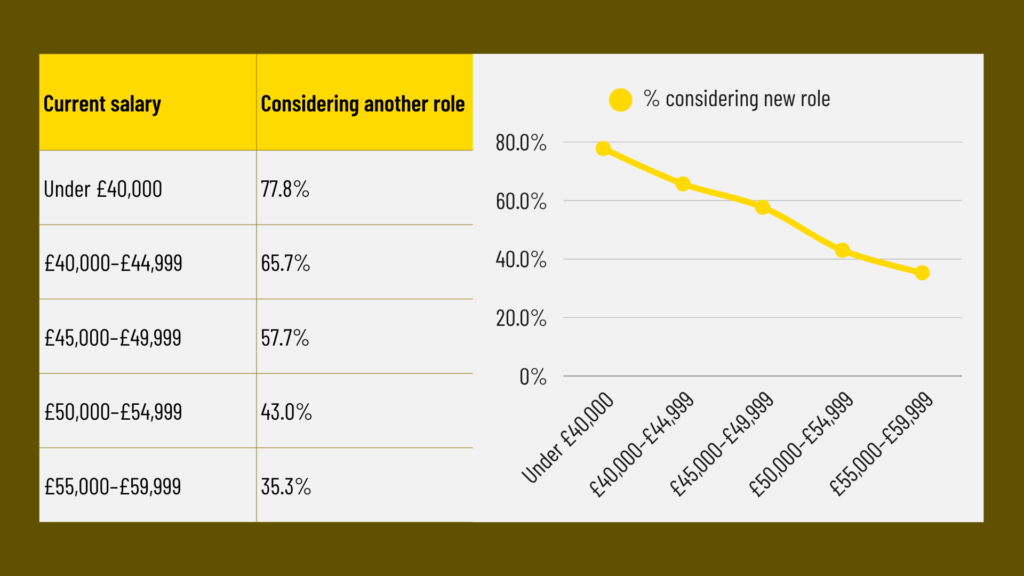
The pattern is difficult to ignore.
Almost 8 in 10 engineers earning below £40,000 are considering changing jobs.
But it’s closer to 1 in 3 for those earning £55k+.
There will always be reasons to leave that have nothing to do with money.
Bad management. Commute. Shift pattern. Lack of progression. Culture.
But the data suggests salary remains a significant retention lever…
KEY TAKEAWAY:
For roles paying below the market, there’s greater risks than the vacancy being difficult to recruit for…. Your existing engineers may already be looking.
What Benefits Are Maintenance Engineers Receiving?
Salary matters, but it’s only one part of the package.
Among engineers who listed their current benefits, the most common were:
| Benefit | % receiving it |
| Company Sick Pay | 66.4% |
| Overtime available up to 2x | 57.6% |
| More than 25 days holiday | 53.9% |
| Enhanced Pension | 51.9% |
| Annual/Monthly Bonus | 44.6% |
| Training & Qualifications | 44.1% |
| Private Healthcare | 35.1% |
| Share Scheme | 14.5% |
Some benefits are now far more common than the phrase “competitive package” might suggest.
More than half of respondents receive an enhanced pension, over 25 days’ holiday and have access to enhanced overtime rates.
KEY TAKEAWAY:
These common benefits aren’t necessarily differentiators anymore.
For many, they’re becoming expectations.
Do Better Benefits Help Retain Engineers?
There is an interesting relationship between benefits and job-search intent.
More engineers NOT considering a new role receive approximately 20% more benefits.
And looking into individual benefits shows another interesting pattern:
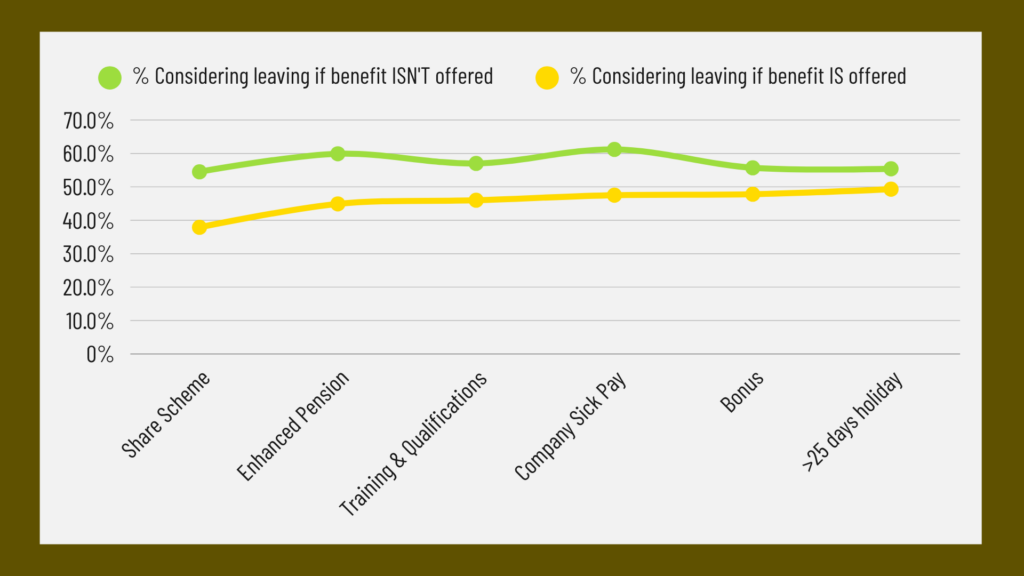
This doesn’t mean giving somebody an enhanced pension will stop them leaving as there are plenty of other factors involved, and correlation isn’t causation.
But these insights suggest that employers shouldn’t underestimate the overall package. Enhanced pensions, training, sick pay and share schemes all show a noticeable relationship with lower job-search activity.
KEY TAKEAWAY:
The flashiest perks might not always be the ones that maintenance engineers value most.
What Does It Actually Take to Make a Maintenance Engineer Move?
One of the most valuable questions we asked was simple:
If you were to move jobs, what salary would you expect?
The average salary was approximately £54,700.
But that changes depending on whether somebody is already considering moving.
Engineers considering another role currently earn an average of approximately £49,684 and expect around £52,738.
That’s an average required uplift of around 6.6%.
Those not currently considering changing jobs earn more (approximately £52,868) and would expect around £56,918 to make a move.
Their average required uplift is approximately 8.6%.
Passive engineers may therefore cost more to tempt away.
KEY TAKEAWAY:
Employers trying to headhunt settled Maintenance Engineers should expect the financial bar to be higher.
What Does This Mean?
For Employers
1. Benchmark against what engineers expect – not just what competitors advertise.
Your competitors’ job adverts tell you what they’re are offering, but not whether engineers actually think it’s enough.
If similar businesses are all advertising the same below-market salary, matching them doesn’t suddenly make the package competitive.
2. Think in percentages when trying to attract someone already employed.
Our average engineer expects roughly a 7–8% uplift when changing jobs.
For engineers specifically seeking an increase, it’s closer to 11.5%.
This means that offering an extra £1,000 to somebody comfortably employed on £50,000 is unlikely to create much urgency.
3. Don’t underestimate the shift premium.
Engineers working shifts earn around 10% more overall than days engineers in our data.
For some engineering biases, the gap is considerably larger.
4. Pay attention to retention before salaries fall behind.
Nearly 78% of respondents earning below £40,000 are considering another role.
Waiting until somebody resigns to review their salary is normally too late.
5. Benefits can strengthen retention.
The people not considering changing jobs reported more benefits overall.
While salary gets attention, a strong overall employment package gives somebody more to lose by leaving.
For Engineers
This data is useful for understanding your position in the market.
A £50k salary might be strong for one combination of location, skillset and shift pattern, but relatively low for another.
So don’t benchmark yourself on job title alone!
Think about:
- Your engineering bias.
- Your shift pattern.
- Your location.
- Your technical skills.
- Your qualifications.
- Your management responsibilities.
- Your total benefits package.
- Overtime and bonus opportunities.
And when considering another job, compare the whole package.
A £3,000 salary increase can quickly become less attractive if you’re losing enhanced pension contributions, overtime rates, holiday entitlement or a better shift pattern.
Advertised Salaries vs. Actual Salaries
Our previous research showed us what employers were putting onto job boards.
This survey gives us the other side.
- What engineers are actually being paid.
- What they’re receiving alongside that salary.
- Whether they’re considering leaving.
- What engineers would expect to earn before making their next move.
Recruitment is much more than the salary you put on a vacancy. These insights can help you understand the point where somebody already employed is prepared to listen. And this data clearly shows that matching their existing package probably isn’t enough.
You can download the full report PDF here:
Need help benchmarking a Maintenance Engineering role?
Our specialist Maintenance Engineering recruitment team speaks to engineers and employers across the UK every day.
Whether you’re benchmarking an existing team, preparing to recruit or struggling to understand why a vacancy isn’t attracting the right people, we can help you understand what the market is telling us.
Speak to our Maintenance Engineering recruitment team or view our latest Maintenance Engineering vacancies.