
Are employers in the East Midlands paying enough to attract and retain Maintenance Engineers?
Our latest research suggests some may need to reconsider their salaries. 61.5% of engineers earning £45k – £50k are considering changing jobs, compared with just 31.8% of those earning £55k+
We surveyed 526 Maintenance Engineering professionals across the UK, including 88 in the East Midlands, to understand what they’re actually earning, what they’d expect to move jobs and which benefits they receive.
Unlike our previous salary reports, which analysed advertised salaries, this research comes directly from engineers themselves.
You can check out the UK-wide report, West Midlands specific report, or continue reading here for insights about Maintenance Engineer salaries in the East Midlands, and what they mean for employers and candidates.
| Metric | East Midlands | UK survey |
| Average current salary | £51,593 | £51,040 |
| Median current salary | £52,000 | £50,000 |
| Average expected salary | £54,900 | £54,697 |
| Median expected salary | £55,000 | £55,000 |
| Average expected uplift | 7.4% | 7.6% |
| Considering a new role | 50.6% | 52.0% |
The East Midlands is closely aligned with the wider UK market. And that feels about right based on what I’m seeing across the region.
However, there’s no single Maintenance Engineer salary. Skillset, seniority and shift pattern all influence earnings, so the average doesn’t necessarily reflect what employers should be offering for a particular role.
Are employers paying enough for Electrical, Mechanical and Multi-Skilled Engineers?
There are some noticeable differences depending on engineering bias.
| Engineering bias | Average current | Average expected | Average uplift | Considering moving |
| Electrical | £52,400 | £54,286 | 4.6% | 42.9% |
| Multi-Skilled | £51,150 | £54,649 | 7.1% | 51.4% |
| Mechanical | £45,900 | £47,833 | 8.4% | 53.8% |
Our Electrical sample was smaller than the Mechanical and Multi-Skilled groups, so those figures should be treated with some caution.
The figure that stands out is Mechanical.
Mechanically biased Maintenance Engineers average £45,900, approximately £5,250 less than Multi-Skilled Engineers and £6,500 less than Electrical Engineers.
That doesn’t massively surprise me. I still speak to experienced mechanical fitters earning below what the wider maintenance market is offering.
What’s interesting is that 53.8% of Mechanical Engineers surveyed are considering another job.
For employers relying on experienced mechanical engineers, particularly those who haven’t received meaningful salary reviews recently, that’s worth paying attention to.
Losing someone with years of knowledge about your machinery and production site can be far more disruptive than increasing their salary.
Is moving into Maintenance Management financially worthwhile?
Salary generally increases with responsibility, but the difference isn’t always as significant as you might expect.
| Job title | Average current | Average expected | Considering moving |
| Maintenance Engineer* | £50,124 | — | — |
| Maintenance Team Leader | £55,592 | £57,458 | 46.2% |
| Maintenance Manager | £62,286 | £66,857 | 71.4% |
Includes Electrical, Mechanical, Multi-Skilled and undisclosed engineering biases.
But I’d question whether some of those salaries are competitive.
For Team Leaders, I’m regularly seeing expectations closer to £60,000, particularly where shifts and strong electrical or Multi-Skilled experience are involved.
And £62,000 isn’t necessarily a high Maintenance Manager salary in today’s market.
Some East Midlands employers are still paying management salaries that haven’t kept pace with engineering salaries underneath them.
That creates situations where a strong shift engineer could earn almost as much as their manager without taking on the additional responsibility.
For employers: If you’re struggling to attract engineers into leadership roles, consider whether the additional salary genuinely reflects the increased responsibility.
Interestingly, 71.4% of Maintenance Managers surveyed were considering another role, although this is a small subgroup and shouldn’t be taken as representative of the whole market.
Is a £2,000 pay rise enough to attract a Maintenance Engineer?
Across the East Midlands, the average salary increase respondents expected was 7.4%.
But the picture changes when we look more closely.
- 68.2% wanted a higher salary to move.
- 20% would consider moving for the same basic salary.
- 11.8% entered an expected salary below their current salary.
Among engineers specifically wanting more money, the average expected increase rises to 12.2%.
That aligns much more closely with what I’m seeing.
If someone is comfortably employed on £50,000, offering £51,000 or £52,000 generally isn’t enough to convince them to leave.
They’re taking a risk. New management, new machinery, another probation period and potentially a longer commute.
From my experience, an additional £4,000–£5,000 is where engineers become much more willing to have a conversation.
For employers setting recruitment budgets, the important question isn’t just what a role should pay. It’s what an engineer would need to leave their current employer.
But salary isn’t everything
The 20% willing to move for the same salary is just as interesting.
Some engineers want a shorter commute, better progression, improved management or a different shift pattern.
I’ve spoken to plenty who would willingly sacrifice some money to come off Nights and move onto straight Days.
So while salary matters, sometimes the job itself is the improvement.
Are engineers considering moving because they’re earning less?
Our research found a noticeable salary difference between engineers considering changing jobs and those who aren’t.
| Metric | Considering moving | Not considering |
| Average current salary | £50,093 | £53,280 |
| Average expected salary | £53,216 | £56,707 |
| Average expected uplift | 7.4% | 7.3% |
Engineers considering moving earn approximately £3,200 less than those who aren’t.
That makes sense to me. Some of the most settled engineers I speak to are already being looked after. They earn a good salary, know their site and aren’t particularly motivated to leave.
Interestingly, both groups expect almost identical percentage increases.
The difference is that engineers not considering moving are starting from a higher salary, making them more expensive to recruit £££.
For employers, this highlights why understanding what your ideal candidate currently earns is just as important as knowing the average market salary.
How much more do shift engineers earn in the East Midlands?
Shift patterns can make a significant difference to earnings.
| Metric | Days | Shift-based |
| Average current salary | £50,444 | £52,910 |
| Median salary | £50,780 | £55,750 |
| Average expected salary | £54,554 | £55,308 |
| Average expected uplift | 8.3% | 6.2% |
| Considering moving | 52.2% | 48.8% |
On average, shift engineers earn approximately £2,466 more than those working Days, a premium of around 5%.
Initially, the Days figure surprised me. £50,000+ feels high for a standard Maintenance Engineer working straight Days. However, this figure includes Team Leaders and Managers.
When we look specifically at core Maintenance Engineer roles, excluding senior positions, the picture changes:
| Core Maintenance Engineer shift pattern | Average salary |
| Days | £47,426 |
| 4 on 4 off | £52,744 |
| Difference | £5,318 |
That’s much closer to what I’m seeing across the region.
There are certainly straight-Days roles paying £50,000, but mid-to-high £40,000s is a realistic benchmark for many standard Days positions.
Is your 4 on 4 off salary still competitive?
Around a year ago, I recruited for 4 on 4 off Days roles paying approximately £45,000. At the time, engineers were interested.
That same salary is much harder to sell today. It’s not that £45,000 is a bad salary. Expectations have simply changed.
Our research puts the average core 4 on 4 off Maintenance Engineer salary at £52,744, although the exact pattern and whether Nights are involved will affect what’s competitive.
If you’re struggling to attract engineers onto shifts, it might not be a lack of candidates holding you back.
Before spending more money advertising a vacancy, check whether the salary you’re offering reflects what engineers on similar patterns are already earning.
At what salary are Maintenance Engineers more likely to consider leaving?
This is one of the strongest findings in our East Midlands research.
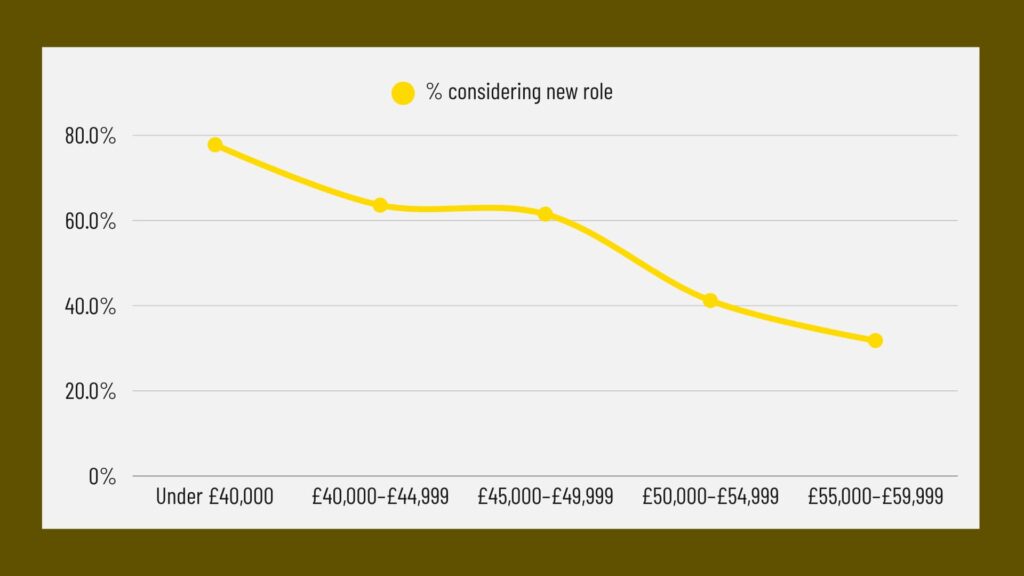
Below £40,000, almost 8 in 10 respondents are considering another job. Then it’s still around 6 in 10 up to £50,000.
But above £50,000, the percentage drops noticeably. And among those earning £55,000–£59,999, fewer than 1/3 are considering moving.
That doesn’t mean paying £55,000 guarantees retention. There’s much more to staying with an employer than salary alone, and these figures show intentions rather than actual resignations.
However, the relationship is difficult to ignore.

KEY TAKEAWAY FOR ENGINEERS:
If you’re an experienced engineer earning below £50,000, particularly on shifts or with strong electrical or Multi-Skilled experience, you may find there are more competitive opportunities available.
KEY TAKEAWAY FOR EMPLOYERS:
Salary benchmarking shouldn’t only happen when you’re recruiting. If your existing engineers are earning below what competitors offer, waiting until they hand in their notice to review salaries could be a costly mistake.
Is your Maintenance Engineer benefits package competitive?
Salary matters, but engineers also consider the overall package.
Here’s what our East Midlands respondents told us they’re receiving.
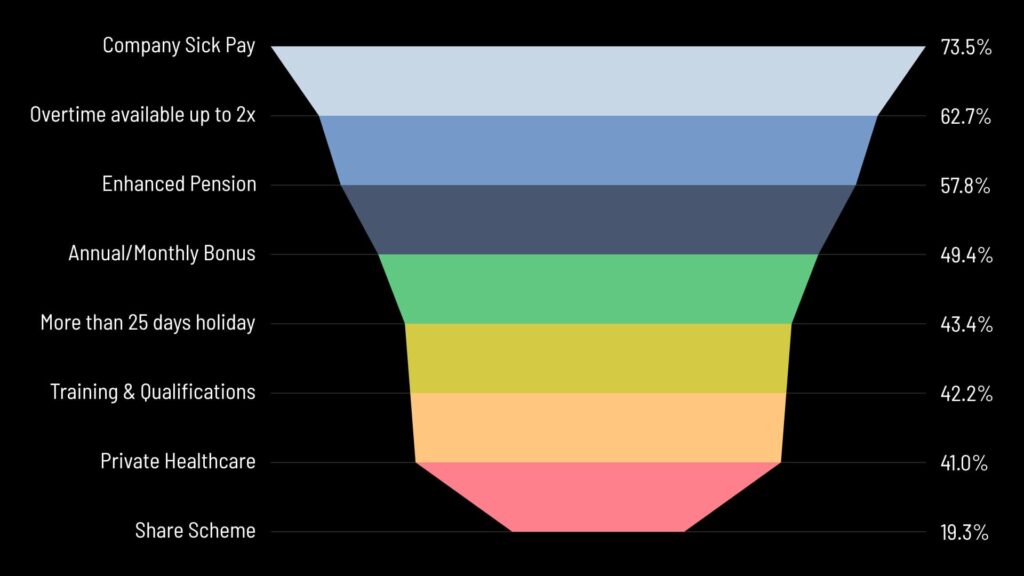
Some of these aren’t necessarily standout benefits anymore.
Nearly 3/4 receive company sick pay, while almost 2/3have access to enhanced overtime.
They’re valuable, but they’re also becoming fairly standard across many Maintenance Engineering packages.
If you’re advertising them as an “excellent benefits package”, candidates might not see them quite the same way.
Do better benefits help retain engineers?
The number of benefits alone didn’t show a particularly strong relationship with job-search intentions in our East Midlands sample.
Engineers considering moving received an average of 3.85 benefits, compared with 3.93 for those not considering moving.
However, some individual benefits showed interesting differences.
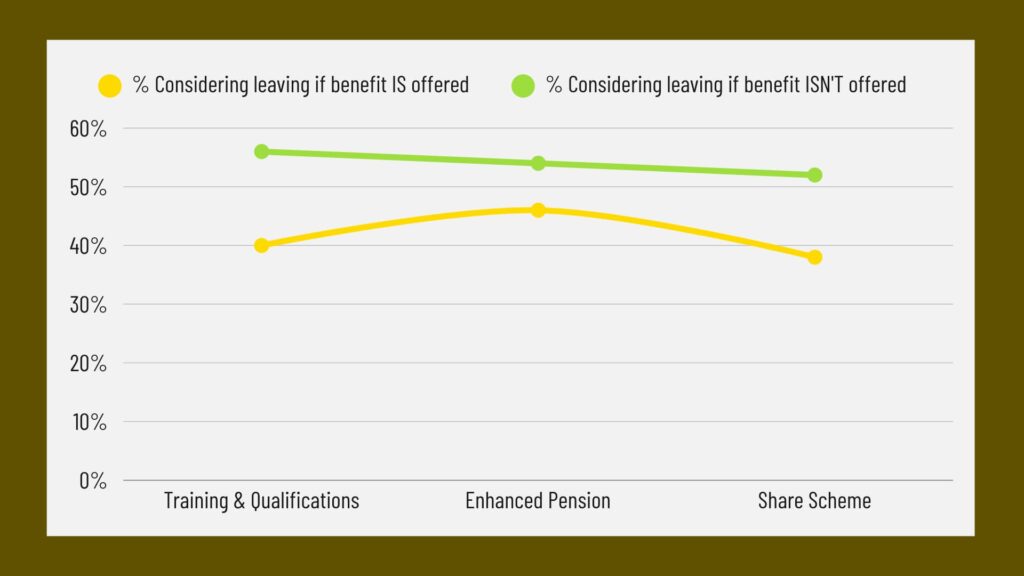
This doesn’t prove those benefits directly improve retention, but development opportunities and long-term financial benefits may give engineers additional reasons to stay.
KEY TAKEAWAY FOR EMPLOYERS:
Speak to your engineers to understand which benefits they genuinely value rather than simply offering more of them.
East Midlands vs West Midlands: Which region pays Maintenance Engineers more?
At first glance, salaries across the East and West Midlands look remarkably similar.
But look beyond the headline averages and the differences become much more relevant to employers.
| Metric | East Mids | West Mids |
|---|---|---|
| Average current salary | £51,593 | £51,818 |
| Median current salary | £52,000 | £50,700 |
| Average desired salary | £54,900 | £54,383 |
| Average individual uplift | 7.4% | 6.3% |
| Considering another role | 50.6% | 47.8% |
| Days-based salary | £50,444 | £48,405 |
| Shift-based salary | £52,910 | £54,147 |
| Shift premium | 4.9% | 11.9% |
The overall average salary difference between the regions is just £225.
But, when comparing shift- and days-based roles, things look a bit different.
Engineers on days in the East Midlands earn around £2,039 more than days-based engineers in the West Midlands. Whereas those on shifts in the West Mids earn £1,237 more on average than their East Midlands counterparts.
The shift premium is also much lower (on average) in the East Midlands (4.9%) than in the West Midlands (11.9%).
Why does this matter?
If you’re recruiting maintenance engineers across both regions, using the same salary benchmarks for every position might not reflect the differences in the surveyed workforce.
A days-based vacancy could face different salary expectations from a shift-based role, even when the engineering skills required are similar.
It’s another reason to consider location, technical requirements and working patterns when reviewing salaries.
For a more detailed look at the neighbouring market, read our West Midlands Maintenance Engineer Salary Report.
What does this mean?
For Employers
There are four main things I’d encourage employers to consider:
1. Salaries that worked two years ago might not work today.
Particularly on shifts. If applications have slowed, review your salary before assuming there’s a shortage of engineers.
2. Don’t expect experienced engineers to move for an extra £1,000 or £2,000.
Among respondents wanting a pay rise, the average expected increase was 12.2%. Make sure your recruitment budget reflects what candidates would realistically accept.
3. Review existing salaries before retention becomes a problem.
Engineers in lower salary bands were more likely to be considering another role. Regular benchmarking could help identify where your team is falling behind the market.
4. Salary isn’t your only competitive advantage.
One in five respondents would consider moving for the same salary. Better shifts, shorter commutes, progression and management can all make a role more attractive.
For Engineers
If you’re an engineer reading this, don’t look at the average and immediately decide you’re underpaid or overpaid.
Your benchmark depends on your skillset, shift pattern, qualifications, experience and responsibilities.
And when comparing opportunities, look beyond the basic pay, and consider overtime, pensions, bonuses, annual leave, commute and work-life balance.
A £5,000 pay rise isn’t necessarily a £5,000 improvement if you lose benefits or move onto a shift pattern that doesn’t suit you. Similarly, earning slightly less could be worthwhile if you’re moving from Nights onto straight Days.
So, what is a good Maintenance Engineer salary in the East Midlands in 2026?
Based on our survey and what I’m seeing across the market:
- Mid-to-high £40,000s is realistic for many standard Days Maintenance Engineer roles.
- £50,000+ is common among experienced Electrical and Multi-Skilled Engineers in our sample.
- Mid-to-high £50,000s can represent a competitive shift-based package, depending on responsibilities and shift pattern.
Are your Maintenance Engineer salaries competitive in 2026?

Whether you’re planning to recruit, reviewing your existing team’s salaries or struggling to attract the right engineers, understanding the market makes a difference.
I recruit Maintenance Engineers across the East Midlands and speak to employers and candidates every day.
If you’re unsure whether your salary, shift pattern or overall package is competitive, I’m happy to share what I’m currently seeing.
And if you’re an engineer wondering how your salary compares, I’m happy to have that conversation too.