
Is your maintenance team being paid enough to stay?
4 in 5 West Midlands maintenance professionals earning under £40,000 are considering another job.
But increase that salary to between £55,000 and £60,000, and the proportion considering leaving falls to around one in three.
That’s one of the biggest findings from our 2026 Maintenance Engineer Salary Survey. And it highlights something important for engineering employers across the West Midlands.
Salary isn’t just a cost of hiring. It’s a factor in retaining the people you’ve already got.
We surveyed 526 maintenance engineering professionals across the UK, including 180 respondents from the West Midlands, to understand what engineers are earning, what they expect from their next role and what might influence their decision to leave.
The results tell us more than just the going rate for Maintenance Engineers. They highlight where employers could be losing good people, where shift patterns affect pay and which benefits are associated with stronger retention.
Here’s what the data tells us:
(click the section you’re most interested in to skip ahead)
- Average Maintenance Engineer salary in the West Midlands
- How much you should pay Mechanical, Electrical and Multi-Skilled Maintenance Engineers
- If moving into maintenance management means earning more
- How much of a salary increase engineers expect to change jobs
- Salary difference between Days and Shifts
- Shift patterns that pay the most in the West Mids
- At what salary Maintenance Engineers are most likely to leave
- Benefits that matter most to West Midlands Maintenance Engineers
- Whether the benefits package influences retention
- West Midlands vs East Midlands
- Key takeaways for employers
- Get help benchmarking your Maintenance Engineer salaries
What is the average Maintenance Engineer salary in the West Midlands?
Average current salary
£51,818
Average desired salary
£54,383
Considering new job
47.8%
Avg. expected salary uplift
6.3%
Maintenance engineering professionals in the West Midlands earn an average of £51,818 – which is slightly above the UK-wide average of £51,040.
However, they’re less likely to be considering a change of job than the national survey population.
| Metric | West Midlands | UK survey |
| Respondents | 180 | 526 |
| Average current salary | £51,818 | £51,040 |
| Median current salary | £50,700 | £50,000 |
| Average desired salary | £54,383 | £54,697 |
| Median desired salary | £55,000 | £55,000 |
| Average individual uplift expected | 6.3% | 7.6% |
| Considering another role | 47.8% | 52.0% |
The average engineer in the region is earning around £780 more than the national benchmark, while reporting a lower average expected percentage uplift.
For employers, this is a useful starting point when reviewing maintenance salaries. But there’s a catch.
The regional average doesn’t tell you what you’ll need to pay for the specific engineer you’re looking for. Their technical specialism, working pattern and willingness to move all influence salary expectations (and that’s where the differences become much more interesting).
Read our full UK Maintenance Engineer Salary Report for a national comparison.
How much should you pay Mechanical, Electrical and Multi-Skilled Maintenance Engineers?
Not all Maintenance Engineers command the same salary.
In the West Midlands, Multi-Skilled Maintenance Engineers earn approximately £5,200 more than Mechanical Maintenance Engineers on average.
But Mechanical Engineers report higher expected percentage salary increases when considering their next move.
| Engineering specialism | Sample | Average current salary | Average desired salary | Average individual uplift | Considering move |
| Mechanical | 23 | £46,465 | £50,591 | 9.4% | 34.8% |
| Electrical | 34 | £49,188 | £53,031 | 9.0% | 41.2% |
| Multi-Skilled | 79 | £51,663 | £53,612 | 5.7% | 49.4% |
What does this mean for employers?
Imagine you’re planning to recruit a Mechanical Maintenance Engineer, the average current salary is £46,465, but respondents in this category would like to earn £50,591 on average.
That gives you a much more relevant benchmark for setting your recruitment budget than simply looking at the overall regional average.
It’s also worth considering candidate availability. As only 34.8% of Mechanical Engineers surveyed are considering another role, compared with 49.4% of Multi-Skilled Engineers.
That doesn’t necessarily mean Mechanical Engineers are harder to recruit. But it does suggest employers targeting this specialism may have a smaller proportion of actively receptive candidates within the surveyed population.

Our advice: Benchmark pay against the engineering skills you actually need, rather than using a single Maintenance Engineer salary band.
Does moving into maintenance management mean earning more?
Career progression is another factor influencing salary expectations.
But moving into management doesn’t always guarantee a higher salary, particularly when shift allowances and overtime are part of the equation.
| Job title | Sample | Average current salary | Average desired salary | Considering move |
| Mechanical Maintenance Engineer | 23 | £46,465 | £50,591 | 34.8% |
| Electrical Maintenance Engineer | 34 | £49,188 | £53,031 | 41.2% |
| Multi-Skilled Maintenance Engineer | 79 | £51,663 | £53,612 | 49.4% |
| Maintenance Team Leader | 24 | £58,367 | £60,417 | 50.0% |
| Maintenance Manager | 6 | £52,841 | £56,200 | 66.7% |
| Head of Engineering | 3 | £74,000 | £73,333 | 33.3% |
Maintenance Team Leaders provide a useful progression benchmark, earning an average of £58,367.
Interestingly, the surveyed Maintenance Managers reported a lower average salary of £52,841. That shouldn’t be interpreted as evidence that management roles generally pay less. The Maintenance Manager sample contains only six respondents, while the Head of Engineering sample contains just three.
It raises an important question for employers:
Are your leadership roles financially attractive enough to encourage experienced engineers to progress?
When comparing technical and management positions, consider the complete package, including shift allowances, bonuses, overtime opportunities and working hours.
For engineers, it’s also worth considering whether a promotion brings the salary, responsibility and lifestyle you’re looking for.
How much of a salary increase do engineers expect to change jobs?
72.5%
Want a salary increase
12.3%
Would consider the same pay
15.2%
Gave a lower desired salary
10.9%
Expected salary uplift on avg.
That average salary uplift is particularly useful when setting a recruitment budget.
For candidates specifically seeking a pay rise, an offer closer to 11% above their current salary may be more aligned with the expectations reported in our survey.
This isn’t a universal requirement though. Engineers will also weigh up working hours, career opportunities, location and benefits. And that’s what can explain why some engineers would consider the same salary or even a lower salary.
Nevertheless, it gives employers a more realistic starting point for conversations about salary.
Do passive candidates expect more money?
The data suggests they do.
| Metric | Considering a move | Not considering a move |
| Average current salary | £49,901 | £53,573 |
| Average desired salary | £52,012 | £56,727 |
| Average individual uplift required | 5.1% | 7.5% |
Engineers who aren’t considering another role currently earn approximately £3,700 more than those who are.
They also report a greater average percentage uplift to move: 7.5%, compared with 5.1%.
That creates two different recruitment scenarios:
If you’re approaching engineers already considering a move, you may be speaking to candidates with lower earnings and modest salary expectations.
But if you’re targeting someone who is settled, earning well and not thinking about leaving, the package may need to be more compelling.
Key takeaway for hiring managers:
Before setting your salary budget, consider whether you’re targeting engineers already open to moving or trying to attract experienced people out of established positions.
That distinction could change your recruitment strategy.
Is your shift pattern costing more than you think?
One of the clearest findings from our West Midlands survey is the pay difference between days and shift-based Maintenance Engineers.
Days-based engineers
£48,405
Average current salary
Shift-based engineers
£54,147
Average current salary
Shift-based respondents earn £5,742 more on average, an 11.9% premium over days-based respondents.
| Days | Shift-based | |
| Respondents | 73 | 107 |
| Average salary | £48,405 | £54,147 |
| Median salary | £47,500 | £54,000 |
| Average desired salary | £51,284 | £56,380 |
| Average individual uplift | 7.4% | 5.6% |
| Considering another role | 57.5% | 41.1% |
Shift workers earn approximately £5,743 more than engineers on days.
But there’s another finding worth paying attention to.
Only 41.1% of shift engineers are considering another job, compared with 57.5% of days-based engineers.
That’s a 16.4 percentage-point difference.
The additional pay associated with shifts may be one factor influencing job satisfaction and retention. However, the survey doesn’t establish that shift premiums directly cause lower move intent.
For employers, the question is whether your shift allowance is competitive enough to attract engineers while recognising the demands of the working pattern.
Multi-Skilled Engineers receive the biggest shift premium
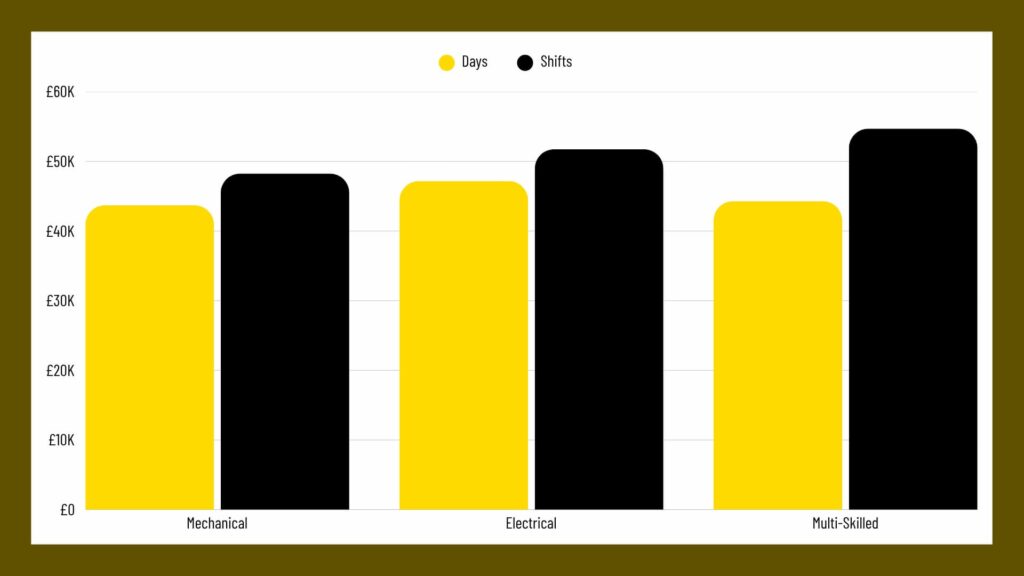
| Specialism | Days salary | Shift salary | Shift premium |
| Mechanical | £43,689 | £48,250 | 10.4% |
| Electrical | £47,173 | £51,740 | 9.7% |
| Multi-Skilled | £44,286 | £54,692 | 23.5% |
Multi-Skilled Maintenance Engineers working shifts earn an average of £10,406 more than those working days.
That’s a 23.5% premium.
This is particularly relevant for employers planning to introduce new shifts, expand production hours or build a Multi-Skilled Engineering team,
Budgeting for a Multi-Skilled Engineer based on the days salary could substantially underestimate the pay levels reported among shift-based engineers.
Something else worth noting is that nearly 2/3 of days-based Multi-Skilled Engineers are considering changing jobs, compared with around 43% of their shift-working counterparts.
That raises a useful question for engineering managers reviewing their team structures: Could the combination of salaries, shift patterns and career opportunities be making certain positions more attractive than others?
The findings don’t tell us the cause, but they provide a reason to investigate.
Which shift patterns pay the most in the West Midlands?
| Shift pattern | Sample | Average current salary | Average desired salary | Considering move |
| Days | 73 | £48,405 | £51,284 | 57.5% |
| Double Days | 24 | £49,506 | £52,542 | 29.2% |
| 3 Shift | 7 | £52,114 | £56,429 | 57.1% |
| Nights | 5 | £54,054 | £47,600 | 80.0% |
| 4 on 4 off | 47 | £56,003 | £57,734 | 42.6% |
| Panama | 9 | £56,390 | £60,111 | 44.4% |
Engineers working a 4 on 4 off pattern earn an average of £56,003.
That’s approximately £7,600 more than the average days-based engineer, representing a 15.7% premium.
Panama shifts show the highest average current salary in this breakdown (£56,390), although the sample is smaller.
The Nights category also reports a high proportion of engineers considering moving (80%). But with only 5 respondents, that figure should be treated cautiously and isn’t a reliable indication of the wider night-shift workforce.
What does this mean when planning a new shift structure?
If you’re considering moving from days to a 4 on 4 off pattern, pay needs to be part of the conversation from the beginning.
The results suggest that engineers working these patterns receive a meaningful salary premium. However, these are comparisons between different groups of respondents, not a direct calculation of the additional allowance an individual employer should pay.
Individual salaries will also depend on experience, engineering specialism, industry and responsibilities.
Key takeaway for maintenance engineers:
This is equally useful when comparing roles.
A higher annual salary may look attractive, but it’s important to understand the hours, nights, weekends and work-life balance involved.
At what salary are Maintenance Engineers most likely to leave?
The relationship between salary and retention is one of the most useful findings from the West Midlands survey.
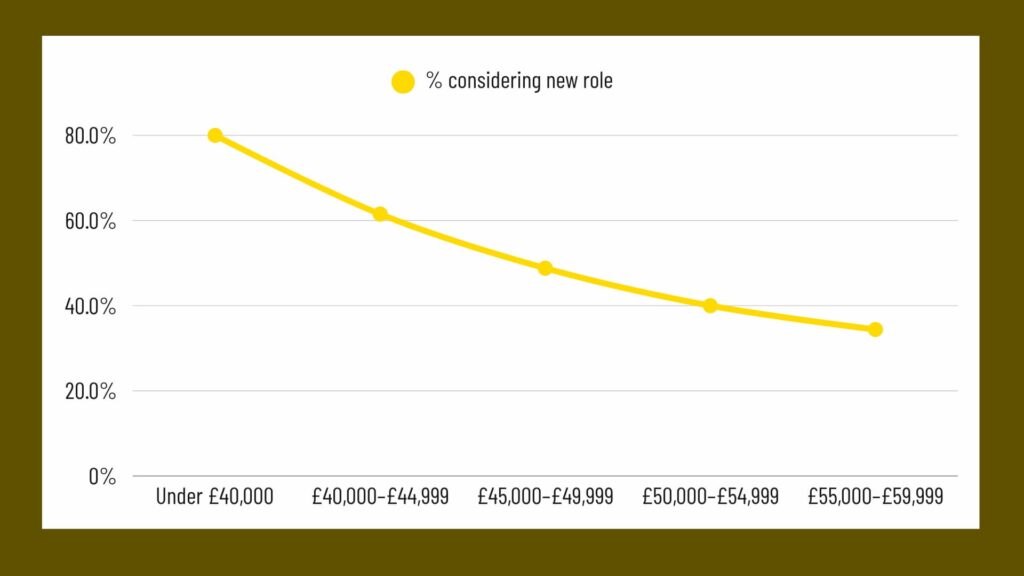
4 in 5 engineers earning below £40,000 are considering another job.
That falls to 61.5% among those earning £40,000–£44,999 and 40% among those earning £50,000–£54,999.
By the time salaries reach £55,000–£59,999, the proportion considering moving drops to 34.4%.
Across the salary bands shown, the trend is consistent. Higher-paid engineers are less likely to be considering another role.
For employers, this provides a reason to review existing salaries before recruitment becomes necessary.
Could a salary review prevent your next vacancy?
Imagine you have a team of Maintenance Engineers earning between £40,000 and £45,000.
Our survey suggests engineers in this salary bracket are more likely to be considering other opportunities than those earning £50,000 or above.
That doesn’t mean everyone needs a £5,000 pay rise, or that increasing pay will guarantee retention.
But it does suggest that reviewing how competitive your salaries are could be worthwhile, particularly for experienced engineers with skills that would be difficult to replace.
The question for employers isn’t just how much it costs to increase salaries. It’s also what happens if your experienced engineers leave and you need to replace them.
Recruitment fees, overtime cover, onboarding, training and lost productivity can all make replacing an experienced engineer expensive.
Salary benchmarking is one way to identify potential retention risks before they become vacancies.
Which benefits matter most to West Midlands Maintenance Engineers?
Salary is important, but it isn’t the only consideration when evaluating a job.
Our survey looked at the benefits that Maintenance Engineers currently receive.
| Benefit | Percentage receiving it |
|---|---|
| Company Sick Pay | 65.6% |
| More than 25 days holiday | 58.1% |
| Overtime paid up to 2x | 56.9% |
| Enhanced Pension | 51.3% |
| Annual/Monthly Bonus | 41.9% |
| Training & Qualifications | 41.9% |
| Private Healthcare | 36.3% |
| Share Scheme | 11.3% |
More than half of West Midlands respondents receive company sick pay, additional annual leave, enhanced overtime rates and an enhanced pension.
These are useful benchmarks for employers.
Offering an enhanced pension or more than 25 days of holiday may be a positive part of your package, but these benefits are already relatively common among surveyed engineers.
The question is whether your total offer is competitive, rather than whether you can include an individual benefit in a job advert.
See how these figures compare nationally in our UK Maintenance Engineer Salary Report.
Could your benefits package be influencing retention?
This is arguably one of the most valuable findings in the entire report.
West Midlands Maintenance Engineers who aren’t considering leaving receive more benefits on average than those who are.
Considering Moving
3.30
Average benefits received
NOT Considering Moving
3.96
Average benefits received
That’s approximately 20% more benefits among the group not considering a move.
But which benefits show the strongest relationships with lower job-search activity?
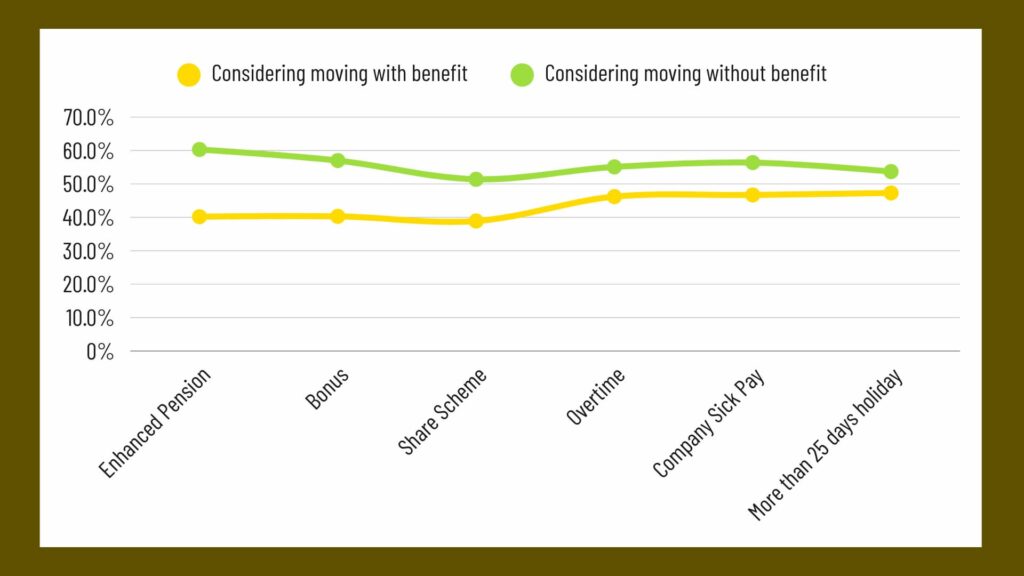
Enhanced pensions stand out
Among respondents who ARE receiving an enhanced pension, 40.2% are considering another role.
Among those who AREN’T, that rises to 60.3%.
Bonuses show a similar pattern. Just 40.3% of engineers receiving a bonus are considering moving, compared with 57% without one.
These findings don’t prove that introducing a pension or bonus will reduce staff turnover. Other factors, including salary, seniority and the type of employer, may influence the results.
But the relationship is strong enough to deserve attention.
Should employers increase salaries or improve benefits?
If you’re reviewing your maintenance team’s pay and benefits, the best approach may not be to focus exclusively on basic salary.
Consider where your current package sits against local expectations.
For example, if your salaries are competitive but your pension offering is relatively weak, improving that benefit could be worth exploring.
Likewise, a bonus scheme, training opportunities or enhanced sick pay may add value to the overall employment package.
For jobseekers, comparing the full package matters too.
An offer with a slightly higher basic salary isn’t necessarily the best financial or career decision once pensions, overtime, bonuses and working hours are taken into account.
Our advice: Review salary and benefits together. The strongest offer isn’t always the one with the highest basic pay.
West Midlands vs East Midlands: Which region pays Maintenance Engineers more?
At first glance, salaries across the East and West Midlands look remarkably similar.
But look beyond the headline averages and the differences become much more relevant to employers.
| Metric | East Midlands | West Midlands |
|---|---|---|
| Average current salary | £51,593 | £51,818 |
| Median current salary | £52,000 | £50,700 |
| Average desired salary | £54,900 | £54,383 |
| Average individual uplift | 7.4% | 6.3% |
| Considering another role | 50.6% | 47.8% |
| Days-based salary | £50,444 | £48,405 |
| Shift-based salary | £52,910 | £54,147 |
| Shift premium | 4.9% | 11.9% |
The overall average salary difference is just £225.
However, the picture changes when we compare shift-based roles.
West Midlands shift engineers earn £1,237 more on average than their East Midlands counterparts.
Meanwhile, days-based engineers in the East Midlands earn £2,039 more than those in the West Midlands.
The shift premium is also substantially greater in the West Midlands, at 11.9%, compared with 4.9% in the East Midlands.
Why does this matter?
If you’re recruiting maintenance engineers across both regions, using the same salary benchmarks for every position might not reflect the differences in the surveyed workforce.
A days-based vacancy could face different salary expectations from a shift-based role, even when the engineering skills required are similar.
It’s another reason to consider location, technical requirements and working patterns when reviewing salaries.
For a more detailed look at the neighbouring market, read our East Midlands Maintenance Engineer Salary Report.
What should West Midlands employers take from the 2026 salary survey?
If you’re responsible for recruiting or retaining Maintenance Engineers, there are several questions worth asking before your next hire.
Are you benchmarking salaries against the right engineers?
The overall regional average is £51,818, but shift pattern and specialism create substantial differences. A Multi-Skilled Shift Engineer may require a very different budget from a days-based Mechanical Engineer.
Is your current salary structure creating retention risks?
Engineers earning under £45,000 report considerably higher job-search intent than those in the £55,000–£59,999 band. Review whether salaries have kept pace with the local market.
Are you budgeting for the candidates you actually want?
Engineers specifically seeking a pay rise report an average expected increase of 10.9%. Those not considering moving also report a higher average required uplift than engineers already thinking about leaving.
Does your benefits package support retention?
Enhanced pensions and bonuses are associated with lower job-search intent. Benchmark the total package rather than focusing only on basic salaries.
These are reasons to make informed decisions using evidence from the people working in your market. Rather than increasing every salary or introducing every possible benefit.
Need to benchmark your Maintenance Engineer salaries?

Knowing the average salary is useful. Knowing whether your offer will attract the engineers you need is much more valuable.
I specialise in West Midlands Maintenance Engineering recruitment, while others in the team can support you with sites elsewhere in the UK.
We speak with Maintenance Engineers and engineering employers every day, giving us insight into the salaries, expectations and recruitment challenges facing the market.
If you’re reviewing your maintenance team’s salaries, planning a new shift structure or preparing for future recruitment, we can help you understand how your offer compares with the wider market.
Let’s have a conversation before your next vacancy becomes urgent.